creature
Dragon
Chaos and evil subdued; size varies from comic to monstrous depending on era.
Iconography & biography archive
Sources: Passio Georgii; Golden Legend (Jacobus de Voragine); widespread military cult; Council of Constance references; national patronages (England, Georgia, Catalonia).

Selected depiction
St. George Victorious over the Dragon (Mattia Preti)
Wikimedia Commons
Martyrs
George of Cappadocia
the soldier-martyr absorbed the dragon legend and became the patron knight of nations—a study in how history, folklore, and heraldry fuse in one figure.
Symbols that identify this saint in sacred art
creature
Chaos and evil subdued; size varies from comic to monstrous depending on era.
object
Primary weapon in the legend; may be broken in narrative moment before final blow.
clothing
Signals knightly status; distinguishes him from semi-nude Sebastian.
symbol
Saint George’s Cross—national and military, not merely decorative.
creature
Equestrian type derives from Roman triumph imagery and knightly culture.
object
Martyrdom by beheading or the Word of God
object
Traditional iconographic attribute associated with this figure in Christian art.
How to read Saint George in paintings, sculpture, and altarpieces
George’s dragon is not zoological—it is moral and political evil, often linked to paganism or chaos threatening a Christian city (Silene in the legend). The lance thrust downward from horseback creates a diagonal composition artists repeated for centuries. When George lacks a dragon, look for red cross on white, youthful knight’s face, and absence of wings (Michael) or arrows (Sebastian). Catalan Sant Jordi pairs the saint with roses and books on 23 April—a civic feast distinct from English St. George’s Day customs.
creature
Chaos and evil subdued; size varies from comic to monstrous depending on era.
object
Primary weapon in the legend; may be broken in narrative moment before final blow.
clothing
Signals knightly status; distinguishes him from semi-nude Sebastian.
symbol
Saint George’s Cross—national and military, not merely decorative.
creature
Equestrian type derives from Roman triumph imagery and knightly culture.
object
Martyrdom by beheading or the Word of God
object
Traditional iconographic attribute associated with this figure in Christian art.
Artists often dress Saint George in white, red, silver—these hues are not rigid rules but long-standing conventions that help recognition in polyptychs and chapel cycles.
Selected depictions of Saint George from verified sources
Wikimedia Commons
Painting
St. George Victorious over the Dragon (Mattia Preti)

Wikimedia Commons
Painting
Saint George (Peter Paul Rubens - St George Fighting the Dragon - )

Wikimedia Commons
Painting
Saint George killing the Dragon (Bosschaert)
Wikimedia Commons
Painting
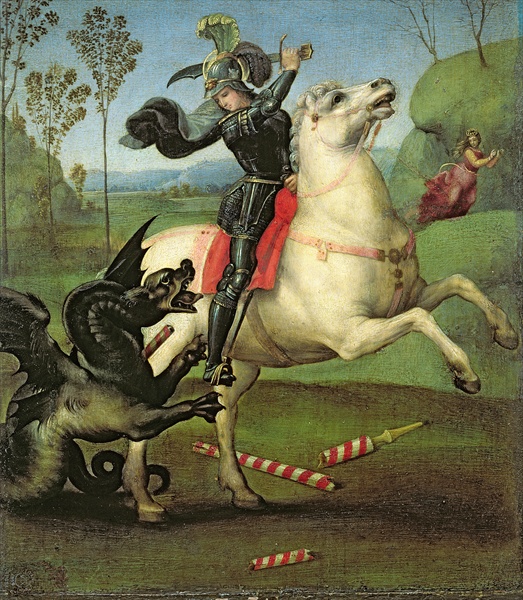
Saint George (Raphael - Saint George Fighting the Dragon.jpg)

Wikimedia Commons
Painting
San Giorgio e il drago (Salvator Rosa)

Wikimedia Commons
Painting
St George and the Dragon (Franz Pforr)

Wikimedia Commons
Painting
Saint George (Rogier van der Weyden, Saint George and the Dragon, )

Wikimedia Commons
Painting
Saint George (Sculpture of Saint George and the Dragon in Mátészal)

Wikimedia Commons
Painting
Saint George (Statue of Saint George and the Dragon at Bode Museum)

Wikimedia Commons
Painting
Saint George and the Dragon (Klontzas)

Museo del Prado
Oil on canvas
Saint George and the Dragon
Peter Paul Rubens

National Gallery of Art, Washington
Oil on panel
Saint George and the Dragon
Raphael

Scuola di San Giorgio degli Schiavoni, Venice
Tempera on canvas
Saint George and the Dragon
Vittore Carpaccio

National Gallery, London
Oil on canvas
Saint George and the Dragon
Tintoretto

National Gallery, London
Oil on canvas
Saint George and the Dragon
Paolo Uccello
Life, witness, and historical framing
demonstrates how a minor historical martyr can absorb a myth and become visual shorthand for an entire culture. English churches place him on rood screens; Georgians name their country after him; Catalans exchange roses in his honor. For iconography students, he is the test case of legend overwhelming history: even when you know the dragon is late, you will see the dragon. Learn the horse, the lance, and the red cross as a system.
Where this figure stands in sacred history
A historical George, soldier under Diocletian, likely died for refusing sacrifice; the dragon story is later, possibly echoing Perseus or local folk combat myths Christianized in the 11th–13th centuries. His red cross on white migrated from crusading symbolism to national flags.
Embodies Christian knighthood: courage, protection of the vulnerable (princess and city), and triumph over evil represented as beast.
How death or vocation shapes devotion and art
Beheading after torture in the historical passion; dragon combat belongs to legend cycles, not court records.
Conventions painters and sculptors repeat
Armored knight on white horse spearing a writhing dragon; princess and city walls in background; red cross on surcoat or banner. Some icons show him as soldier-martyr without dragon.
Saint George and the Dragon — Raphael (c. 1505)
Princess, broken lance, and restrained dragon clarify narrative roles.
Clues ordered for museum identification
Most depicted legendary scene
Represents his military status
Emblem of Saint George, flag of England
Weapon with which he defeats evil
The maiden rescued in the legend
Quick checklist
Dragon + lance + horse + armor. Michael has wings and may trample Satan without a princess narrative.
Why communities invoke this figure
Patron of England, Georgia, Catalonia, Portugal, scouts, and soldiers.
Ideas encoded in attributes and color
Avoid common misidentifications in galleries
Archangel Michael — Both combat serpentine evil.
How to tell them apart: Michael has wings, no horse in most masterpieces, and may hold scales; George is human, armored, often on horseback with a princess nearby.
Scholarly curiosities and cult details
George demonstrates how a minor historical martyr can absorb a myth and become visual shorthand for an entire culture. English churches place him on rood screens; Georgians name their country after him; Catalans exchange roses in his honor. For iconography students, he is the test case of legend overwhelming history: even when you know the dragon is late, you will see the dragon. Learn the horse, the lance, and the red cross as a system.
Other Martyrs figures you might want to explore


