scene
Christ Child
Foster father holding or presenting Jesus in Holy Family and Flight scenes.
Iconography & biography archive
Sources: Matthew 1–2; Luke 2; apocryphal Protoevangelium of James (lily staff episode); declared patron of universal Church 1870 (Quemadmodum Deus).
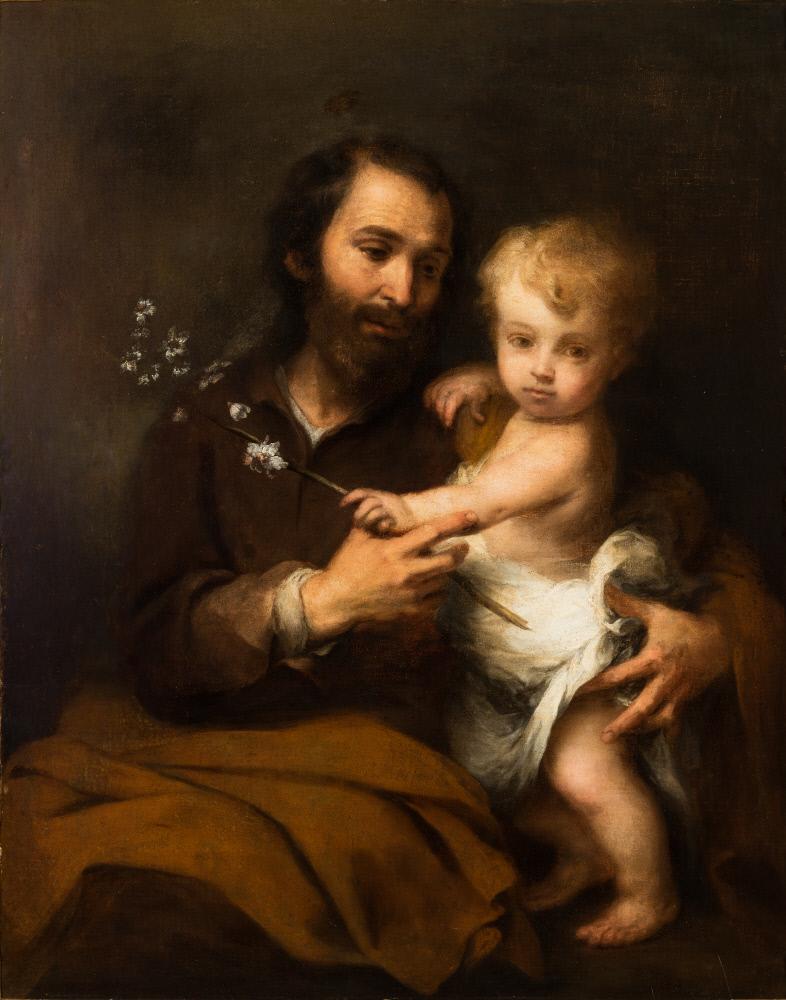
Selected depiction
Saint Joseph and Christ Child (Murillo)
Wikimedia Commons
Saints
Joseph of Nazareth
the carpenter—silent in scripture, eloquent in art—guards the Holy Family with lily staff and patient labor, patron of the Church and of fathers.
Symbols that identify this saint in sacred art
scene
Foster father holding or presenting Jesus in Holy Family and Flight scenes.
symbol
Blooming staff signifying chosen virgin guardian in apocryphal marriage contest.
object
Walking stick in journey scenes; may bloom with lilies in marriage iconography.
object
Square, plane, or saw—honest work and Nazareth household.
object
His trade as a craftsman
How to read Saint Joseph in paintings, sculpture, and altarpieces
Joseph’s lily staff comes from the Protoevangelium: suitors place rods in the temple; Joseph’s blooms. That miracle story explains why he carries botany while Anthony carries the living Child on a book. Tools identify his trade without turning him into a generic laborer—look for square, plane, or saw in Holy Family workshops. Spanish and Latin American colonial art intensified Joseph’s youth in some periods, but the default remains older guardian to contrast Mary’s perpetual youth.
scene
Foster father holding or presenting Jesus in Holy Family and Flight scenes.
symbol
Blooming staff signifying chosen virgin guardian in apocryphal marriage contest.
object
Walking stick in journey scenes; may bloom with lilies in marriage iconography.
object
Square, plane, or saw—honest work and Nazareth household.
object
His trade as a craftsman
Artists often dress Saint Joseph in brown, green, gold—these hues are not rigid rules but long-standing conventions that help recognition in polyptychs and chapel cycles.
Selected depictions of Saint Joseph from verified sources
Wikimedia Commons
Painting
Saint Joseph and Christ Child (Murillo)

Wikimedia Commons
Painting
Saint Joseph the Carpenter (La Tour)

Wikimedia Commons
Painting
Saint Joseph Leading Christ Child (Murillo)

Musée du Louvre
Oil on canvas
Saint Joseph the Carpenter
Georges de La Tour

Wikimedia Commons
Painting
Saint Joseph (La Tour - Saint Joseph charpentier, vers 1642 - 1644)

Wikimedia Commons
Painting
Saint Joseph and the Christ Child

National Gallery of Art, Washington
Oil on panel
Saint Joseph and the Christ Child
Giovanni Battista Cima da Conegliano
Life, witness, and historical framing
silence in the Gospels let artists supply personality: sleeping, traveling, working. He is the saint of the background who makes the Incarnation domestic. In museums, he anchors Holy Family compositions—without him, Mary and Jesus float in timeless Madonna space; with him, the scene becomes household. Trust the lily staff and the tools before you trust a generic bearded man near a child.
Where this figure stands in sacred history
Betrothed to Mary, Joseph resolved to dismiss her quietly before the angelic dream; he protected the child in Bethlehem, fled to Egypt, and raised Jesus in Nazareth. His absence from the public ministry and Passion narratives leaves artists freedom to show him as aged guardian rather than disciple.
Legal father of Jesus, provider, and model of obedient sleep in dream sequences. His cult grew slowly until the medieval and early modern periods, then surged with Teresa of Ávila and popular devotions.
How death or vocation shapes devotion and art
“Patron of a happy death” tradition—dying in the presence of Jesus and Mary—shapes deathbed prayers though not biblical narrative.
Conventions painters and sculptors repeat
Mature bearded man, often gray; lily staff; Christ Child in arms or nearby; carpenter’s square or tools; sleeping pose in Annunciation cycles; comparatively plain dress versus Joseph of Arimathea’s rich robes.
The Holy Family — Murillo (17th century)
Joseph as gentle older father—no lily staff but unmistakable familial grouping.
Clues ordered for museum identification
Foster father of Jesus
Symbol of purity and his selection as Mary's spouse
His trade as a craftsman
Traditional depiction as mature guardian
Quick checklist
Lily staff + Christ Child + mature male in family grouping. Anthony wears a friar’s habit; Joseph does not.
Why communities invoke this figure
Patron of workers, fathers, carpenters, and the dying; universal Church patron.
Ideas encoded in attributes and color
Avoid common misidentifications in galleries
Saint Anthony of Padua — Both hold the Christ Child in Baroque devotion.
How to tell them apart: Anthony is a tonsured friar with brown habit and book; Joseph is a lay guardian with lily staff and tools, no Franciscan cord.
Scholarly curiosities and cult details
Joseph’s silence in the Gospels let artists supply personality: sleeping, traveling, working. He is the saint of the background who makes the Incarnation domestic. In museums, he anchors Holy Family compositions—without him, Mary and Jesus float in timeless Madonna space; with him, the scene becomes household. Trust the lily staff and the tools before you trust a generic bearded man near a child.
Other Saints figures you might want to explore

