symbol
Scallop Shell
Scallop of Santiago—sewn to hat or cloak; pilgrims still wear it today.
Iconography & biography archive
Sources: Mark 1:19–20; Matthew 20:20–23; Acts 12:2; Breviarium apostolorum; Codex Calixtinus.
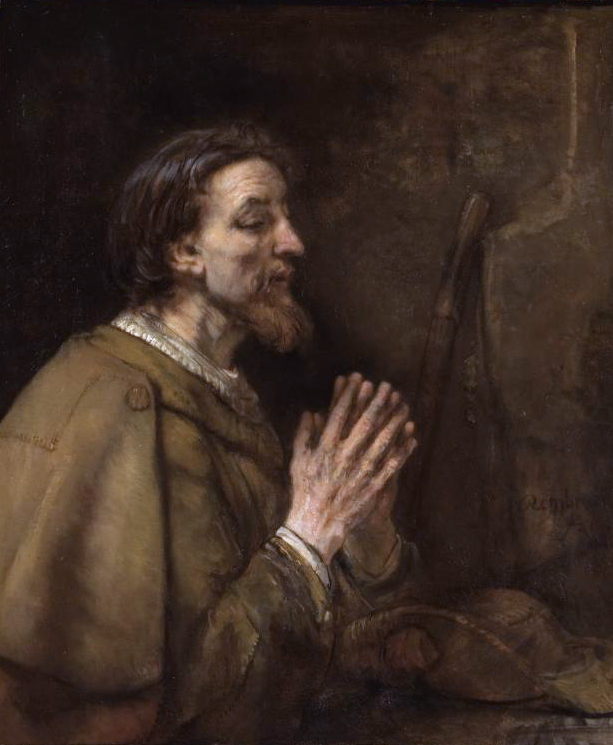
Selected depiction
Saint James the Greater
Web Gallery of Art / private collection
Apostles
James the Apostle
son of Zebedee—apostle, martyr, and patron of Spain—wears the scallop shell of a million pilgrims on the road to Compostela.
Symbols that identify this saint in sacred art
symbol
Scallop of Santiago—sewn to hat or cloak; pilgrims still wear it today.
object
Walking stick of the Camino, sometimes with gourd attached.
clothing
Wide-brimmed hat of Camino pilgrims
object
Pilgrim equipment
object
Matamoros iconography only—do not use alone without shell or horse context.
object
Gospels, doctrine, or wisdom
How to read Saint James the Greater in paintings, sculpture, and altarpieces
Two James types coexist: the pilgrim (hat, staff, shell, gourd) and the Matamoros knight (horse, sword, Moorish foe). Spanish colonial art favors the warrior; French and Italian altarpieces favor the pilgrim. The shell is not decorative—it is documentary of pilgrimage, often replicated in plaster on houses along the route.
symbol
Scallop of Santiago—sewn to hat or cloak; pilgrims still wear it today.
object
Walking stick of the Camino, sometimes with gourd attached.
clothing
Wide-brimmed hat of Camino pilgrims
object
Pilgrim equipment
object
Matamoros iconography only—do not use alone without shell or horse context.
object
Gospels, doctrine, or wisdom
Artists often dress Saint James the Greater in brown, ochre, red—these hues are not rigid rules but long-standing conventions that help recognition in polyptychs and chapel cycles.
Selected depictions of Saint James the Greater from verified sources
Web Gallery of Art / private collection
Oil on panel
Saint James the Greater
Rembrandt

Museo del Prado
Oil on panel
Santiago el Mayor (Saint James the Greater)

Wikimedia Commons
Painting
Saint James the Greater (Ribera)

Wikimedia Commons
Painting
Saint James the Greater (El Apóstol Santiago a caballo o Santiago Matamoros, )

Wikimedia Commons
Painting
Saint James the Apostle (Treviso)

Wikimedia Commons
Painting
Saint James the Greater (Antonio Veneziano - Apostle James the Greater - WGA0)

Wikimedia Commons
Painting
Saint James the Greater (James the Greater Apostle Hajdudorog Frame.jpg)

Wikimedia Commons
Painting
Saint James the Greater (Reni - The Apostle James the Greater, 1618 - 1623.jp)

Wikimedia Commons
Painting
Saint James the Greater (The Apostles in the Bowyer Bible James the Greater M)

Wikimedia Commons
Painting
Saint James the Greater (icon)

Wikimedia Commons
Painting
Saint James the Greater (Mexican Colonial)

Wikimedia Commons
Painting
James the Greater (Bowyer Bible)

Wikimedia Commons
Painting
James the Greater (Goltzius)
Life, witness, and historical framing
proves that geography shapes iconography: a Galilean fisherman becomes the patron of an entire peninsula because relics and pilgrimage demand visual signs. When you see the shell, think movement—roads, hospitals, badges—not merely seaside metaphor.
Where this figure stands in sacred history
One of the first called fishermen, witness of the Transfiguration, and the only apostle whose martyrdom Acts records (beheaded by Herod Agrippa, c. 44 AD). Medieval legend transported his body to Galicia, creating the Camino de Santiago.
“Sons of thunder” with John; patron of the Reconquista imagination in Spain as Santiago Matamoros as well as pilgrim protector.
How death or vocation shapes devotion and art
First apostolic martyrdom recorded in Acts—beheading in Jerusalem.
Conventions painters and sculptors repeat
Pilgrim with shell and staff, or mounted knight with sword; water gourd and wide hat in travel scenes.
Clues ordered for museum identification
Typical pilgrim attire to Compostela
Symbol of the Camino de Santiago
The quintessential Jacobean symbol
Pilgrim equipment
Representation as protector of Spain in battle
Quick checklist
Scallop shell is definitive; Matamoros type needs horse and sword plus Spanish context.
Why communities invoke this figure
Patron of Spain, pilgrims, knights; July 25 feast anchors summer pilgrimage season.
Avoid common misidentifications in galleries
Often confused with saint roch: Both appear in pilgrim attire
Scholarly curiosities and cult details
James proves that geography shapes iconography: a Galilean fisherman becomes the patron of an entire peninsula because relics and pilgrimage demand visual signs. When you see the shell, think movement—roads, hospitals, badges—not merely seaside metaphor.
Other Apostles figures you might want to explore


