object
Sword
Marks beheading at Tre Fontane (Roman tradition) and, in allegorical readings, the living Word. Do not confuse with military saints who wear armor without books.
Iconography & biography archive
Sources: Acts 7–28; Romans, Corinthians, Galatians, Ephesians, Philippians, and other epistles; 2 Timothy tradition of Roman execution; Clement of Rome on Paul’s martyrdom with Peter.

Selected depiction
Saint Paul
Museo del Greco, Toledo
Apostles
Saul of Tarsus
of Tarsus—Pharisee, persecutor, and apostle to the Gentiles—carries the sword of his martyrdom and the books of his letters, shaping how theology looks in paint.
Symbols that identify this saint in sacred art
object
Marks beheading at Tre Fontane (Roman tradition) and, in allegorical readings, the living Word. Do not confuse with military saints who wear armor without books.
object
Represents the Pauline corpus—sometimes open to Romans or Corinthians in humanist altarpieces.
object
Earlier or Byzantine forms prefer scrolls to codices; same theological meaning as the book.
object
Traditional iconographic attribute associated with this figure in Christian art.
How to read Saint Paul in paintings, sculpture, and altarpieces
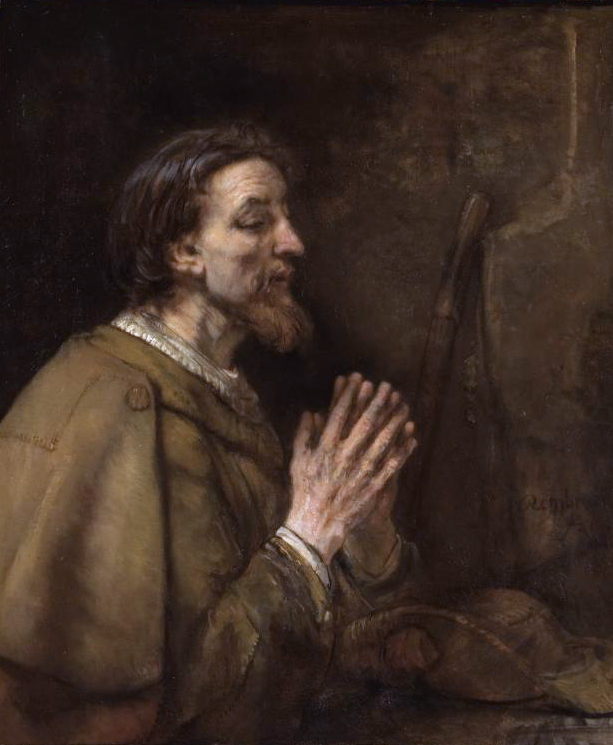
Paul’s portrait type was fixed by the 4th–6th century and reinforced in Byzantine and Latin traditions. Unlike Peter’s institutional keys, Paul’s book points to textual authority—his epistles were debated, collected, and finally canonized. When Paul appears without a sword in post-Reformation art, he may still be identifiable by balding pattern and scholarly dress. The “Conversion of Saint Paul” is a separate iconographic genre: fallen rider, divine light, attendants—useful for recognition even when later portraits omit the horse. In paired statues on Roman bridges and church façades, Paul’s sword balances Peter’s keys: martyrdom and office, Gentile mission and Petrine stability.
object
Marks beheading at Tre Fontane (Roman tradition) and, in allegorical readings, the living Word. Do not confuse with military saints who wear armor without books.
object
Represents the Pauline corpus—sometimes open to Romans or Corinthians in humanist altarpieces.
object
Earlier or Byzantine forms prefer scrolls to codices; same theological meaning as the book.
object
Traditional iconographic attribute associated with this figure in Christian art.
Artists often dress Saint Paul in red, green—these hues are not rigid rules but long-standing conventions that help recognition in polyptychs and chapel cycles.
Selected depictions of Saint Paul from verified sources
Museo del Greco, Toledo
Oil on canvas
Saint Paul
El Greco

National Gallery, London
Oil on canvas
Saint Paul (San Pablo)
Diego Velázquez

Wikimedia Commons
Painting
Saint Paul (The Apostle Paul (detail) - Google Art Project.jpg)

Wikimedia Commons
Painting
Saint Paul detail (El Greco Museum)

Wikimedia Commons
Painting
Saint Paul (Georges de La Tour)

Wikimedia Commons
Painting
Saint Paul (Montagna)

Wikimedia Commons
Painting
Saint Paul (Ribera)

Wikimedia Commons
Painting
The Apostle Saint Paul (van Dyck)

Wikimedia Commons
Oil on panel
Apostle Paul (Rubens)
Peter Paul Rubens
Life, witness, and historical framing
surviving letters let us hear a voice arguing, consoling, and rebuking real communities—Corinthian factions, Galatian circumcision debates, Roman greetings to households. That urgency translates into art as a man who reads and acts. His martyrdom paired with Peter’s on 29 June made Rome the visual capital of apostolic memory. In any gallery, treat the sword as Paul’s primary key: once identified, the book confirms the theologian, and the bald head distinguishes him from younger sword-bearing knights.
Where this figure stands in sacred history
Paul’s letters (50s–60s AD) are earlier than the Gospels and document real communities in Corinth, Galatia, and Rome. Acts narrates his conversion on the Damascus road, missionary journeys, arrest, voyage to Rome, and house arrest. Roman citizenship explains beheading rather than crucifixion—a distinction artists encode with the sword.
He rethought Torah, circumcision, and Gentile inclusion; his intellectual intensity appears in art as a lean, bald, bearded reader or preacher. The “apostle to the Gentiles” expands Christian identity beyond Judea, which is why his sword also symbolizes the Word that pierces hearts (Hebrews 4:12; Ephesians 6:17 in later interpretation).
How death or vocation shapes devotion and art
Beheaded as civis Romanus. The sword is never decorative in Pauline iconography—it is the instrument of death and, allegorically, scripture’s cutting edge.
Conventions painters and sculptors repeat
Long dark beard, high bald forehead, intense gaze, red tunic (martyrdom), green cloak, sword in right hand, book or scrolls in left. Conversion scenes use blinding light and fallen horse (Acts 9:3–4, elaborated in art).
The Conversion of Saint Paul — Caravaggio (c. 1601)
Teaches recognition of Paul in narrative mode before apostolic portrait attributes appear.
Clues ordered for museum identification
Instrument of his martyrdom (beheading) and symbol of the Word of God
Represents his epistles and his work as a theologian
Traditional iconography, more intellectual appearance
Red symbolizes his martyrdom
Quick checklist
Sword + book + bald pate + long beard = Paul in 90% of Western panels. James the Greater may carry a sword in Spanish Matamoros guise but adds pilgrim shell and hat.
Why communities invoke this figure
Patron of theologians, writers, publishers, and Malta; model of radical conversion.
Ideas encoded in attributes and color
Avoid common misidentifications in galleries
Saint Peter — Shared feast and Roman civic patronage.
How to tell them apart: Peter has keys and a shorter beard; Paul has sword and book and a longer beard with more bare scalp.
Saint James the Greater — Both can appear with swords in Spanish art.
How to tell them apart: James adds scallop shell, pilgrim staff, or equestrian Moorslayer context; Paul never wears pilgrim insignia.
Scholarly curiosities and cult details
Paul’s surviving letters let us hear a voice arguing, consoling, and rebuking real communities—Corinthian factions, Galatian circumcision debates, Roman greetings to households. That urgency translates into art as a man who reads and acts. His martyrdom paired with Peter’s on 29 June made Rome the visual capital of apostolic memory. In any gallery, treat the sword as Paul’s primary key: once identified, the book confirms the theologian, and the bald head distinguishes him from younger sword-bearing knights.
Other Apostles figures you might want to explore